
Why Your Chimney's Foundation Decides How the Rest of Your House Ages
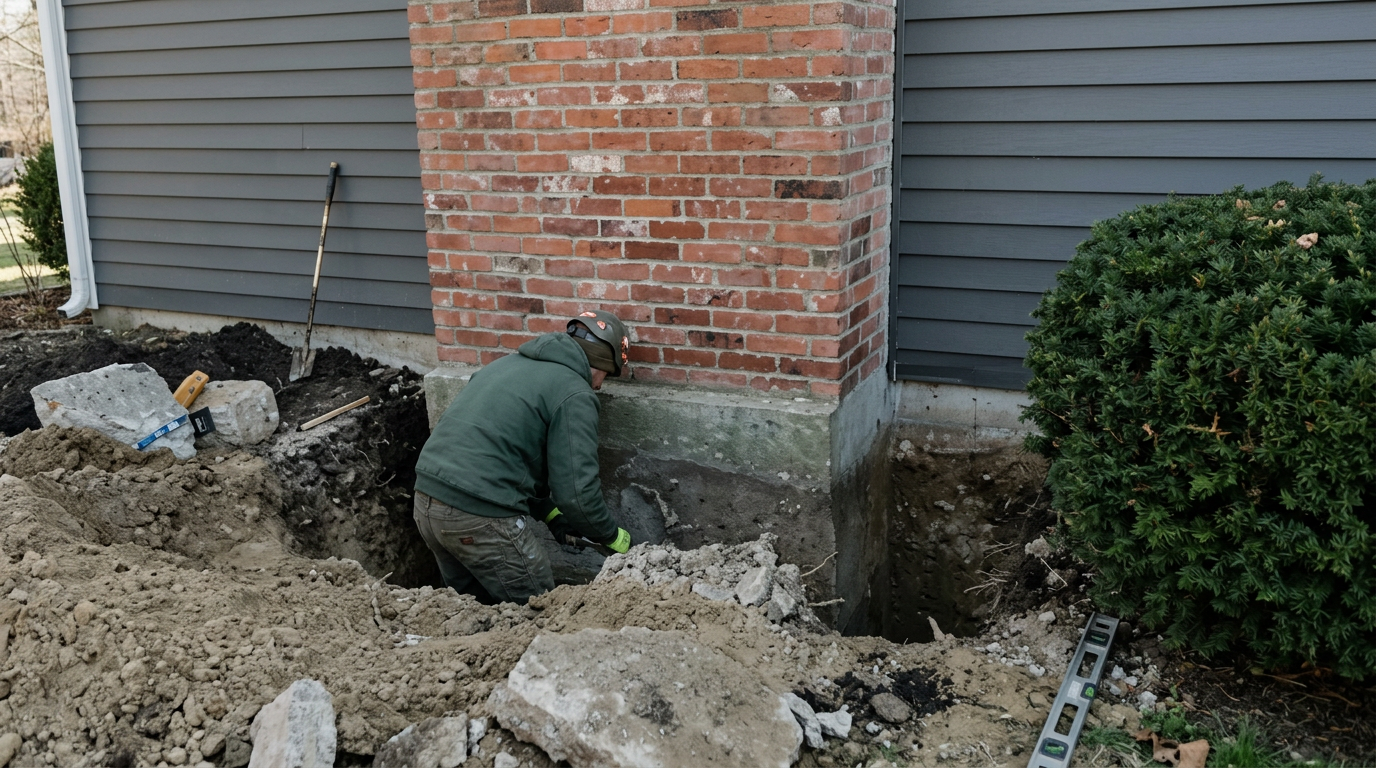
Excavating down to a settling chimney footing.
If you live in North Texas, you already know what our soil does in August. It bakes. The ground pulls back from the house, opens up cracks you could lose a garden hose in, and then the first real rain comes through and swells it all back up like a sponge. Wet, dry, then wet again. We do this dance every single year, and most folks never think twice about it — until something on the house starts moving.
The first thing that usually moves is the chimney. And here's the part a lot of people don't realize until I'm standing in their backyard with a shovel: when the chimney foundation shifts, it rarely keeps that problem to itself. It hands it right down the wall to your siding, your flashing, and your brick.
Let me walk you through why that happens, because once you understand it, you'll spot the early warning signs long before they turn into a big repair.
Your chimney sits on its own foundation
A lot of homeowners picture the chimney as part of the house, tied into everything else. It's really its own structure. It stands on a concrete pad called a footing, and that footing carries an enormous amount of weight — brick, block, flue, and cap, all stacked straight up. That's a heavy, narrow column resting on one spot in the ground.
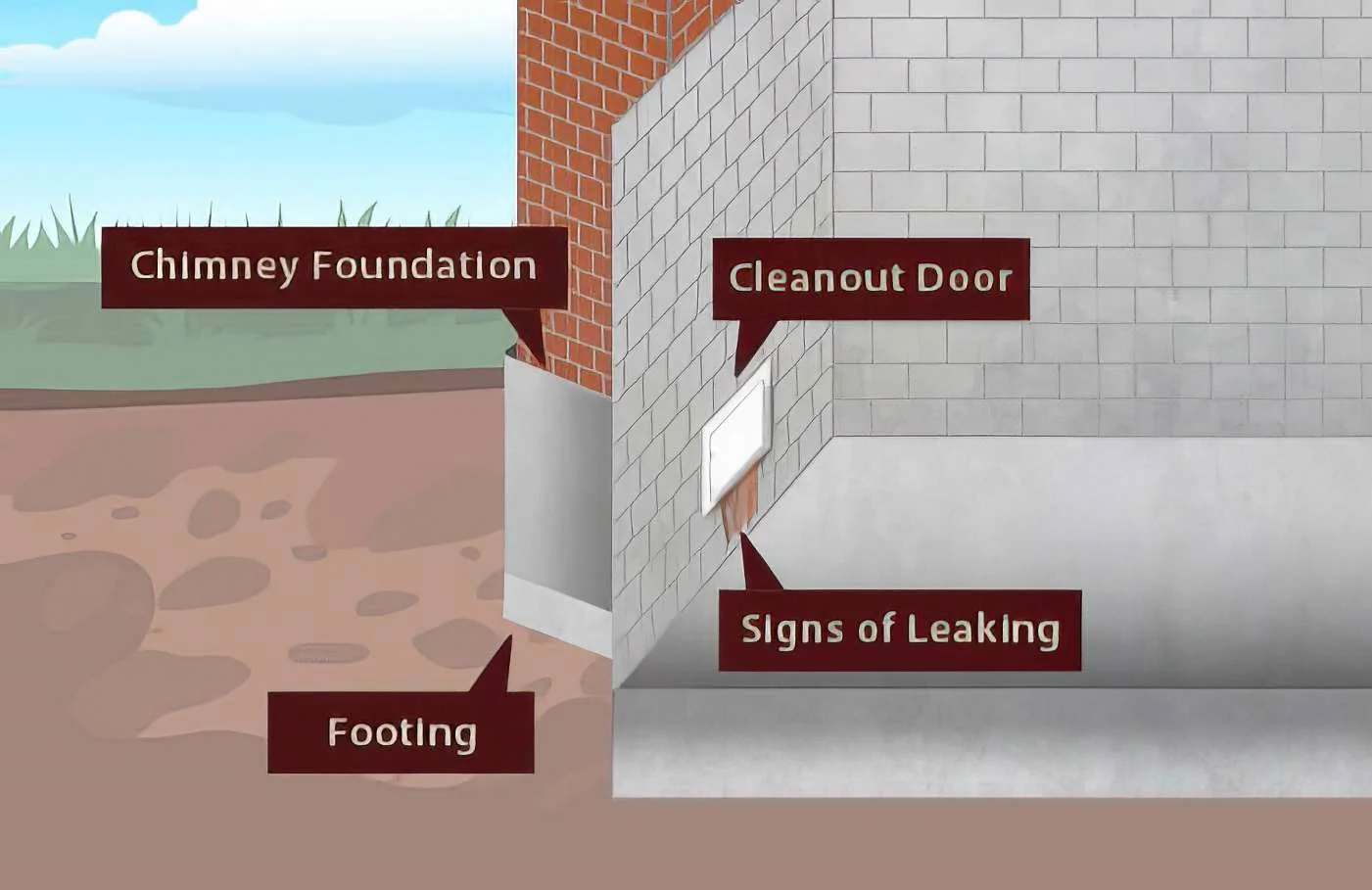
The parts of a chimney foundation — and where leaks show up first.
When the soil under that footing is stable, everything holds. But our North Texas clay is anything but stable. It's expansive soil, which is just a fancy way of saying it grows when it's wet and shrinks when it's dry. In the span of one summer it can do both, more than once. That footing is riding on ground that's constantly changing its mind about how much space it wants to take up.
Over time, that movement tips the chimney, ever so slightly. You won't see it happen. You'll see what it leaves behind.
How the movement travels into your siding and brick
This is the part that surprises people. The chimney and the wall it's attached to are connected — by flashing at the roofline, by siding that butts right up against the masonry, and sometimes by the same run of brick. So when the chimney leans even a fraction of an inch, it pulls and tugs on everything it touches.
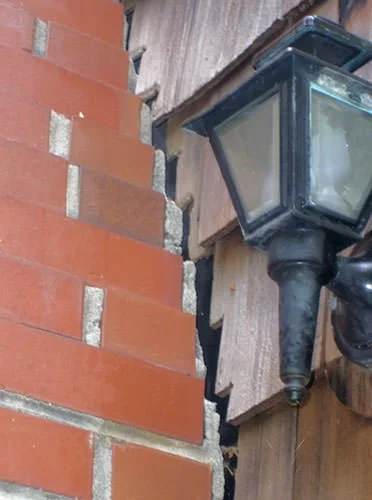
When the chimney shifts, it opens a gap at the siding — an open door for water.
You start to see it show up as stair-step cracks running through the mortar joints, like the ones in the photo above. You might notice a gap opening between the siding and the chimney where there used to be a clean seam. Flashing that used to sit tight can lift or separate, and that's an open door for water. On brick homes, you'll sometimes catch the whole chimney pulling away from the wall, with a visible gap at the corner.
None of that is cosmetic. Every one of those gaps is a path for water to get behind your siding and into the wall — and once water is behind the wall, you've traded a foundation problem for a rot problem. That's why we always tell folks the chimney is the canary in the coal mine for the rest of your exterior. It moves first, and it tells on itself early if you know what to look for.
The signs worth walking outside to check
Next time you're out in the yard, take two minutes and look at the base of your chimney and the wall around it. A few things are worth your attention.
Look low, at the cleanout door and the bottom courses of brick, for staining or a damp, rusty streak — that's a sign water is already finding its way in. Look at the seam where the siding meets the chimney and see whether it's still tight or starting to open. Step back and check whether the chimney looks like it's standing dead straight or leaning just slightly off the wall. And run your eye along the mortar for those stair-step cracks.
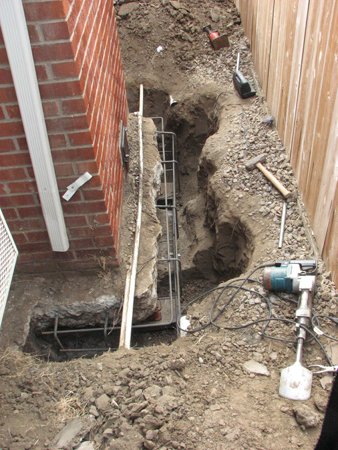
Rebar set and ready — rebuilding the chimney's footing so it has something solid to stand on again.
If you catch a couple of those, it doesn't automatically mean a big job. Caught early, a lot of this is very manageable. We can excavate down to the footing, see exactly what the soil has done, and rebuild the base properly so the chimney has something solid to stand on again — like in the photo above, where we've got the footing exposed and reinforced before the pour. Then we address the siding, the flashing, and the brick so water stays out and stays out for good.
Why this matters most right now
We're in the thick of it. August in North Texas is the dry end of the wet-dry-wet cycle, and the ground is shrinking hard right now. The stress from spring's damage is still working its way through the house, and the summer heat is pulling the soil back away from your footings. This is the season those cracks and gaps open up the widest and become the easiest to spot. It's also the best window to get ahead of it, before the fall rains swell everything back up and drive water into any gap that opened over the summer.
With over 700 five-star reviews from your neighbors across North Texas, we've seen this pattern more times than I can count, and we know how to fix it right the first time.
If any of this sounds like your house — the cracks, the leaning, the gap at the siding — the smartest thing you can do is have someone take a look before the weather turns. It costs you nothing to know where you stand.
Give us a call and we'll come take a look: (469) 777-8432.
A few common questions
Will my homeowner's insurance cover chimney foundation work? It depends entirely on your policy and what caused the damage. Some situations are covered and some aren't, so it's always worth a call to your carrier to ask. We're happy to document what we find so you have what you need for that conversation.
Is a leaning chimney dangerous? A slight lean caught early is usually a repair, not an emergency. But a chimney that's visibly pulling away from the house shouldn't be ignored, because the longer it moves, the more it takes the wall with it. When in doubt, have it looked at.
How long does a foundation repair like this take? Every home is different, and the honest answer is that we won't know for sure until we've had eyes on your chimney and, in most cases, opened up the base to see what the soil has done. We'll give you a clear, single project total once we do — no surprises.
Sweeps N Ladders — chimney, fireplace, and exterior care for North Texas. Call (469) 777-8432.