
The Chimney Cap: Your First Line of Defense
If it fails quietly, everything below it pays the price.
If you have never looked at your chimney cap, you are not alone. Most homeowners couldn’t tell you if they have one, let alone whether it’s intact. But it matters more than almost anything else on the list.
The chimney cap is the metal cover sitting at the very top of your flue. It keeps rain out. It keeps birds and squirrels from nesting inside. It keeps embers from landing on your roof during a fire. When it rusts, cracks, or disappears entirely — and it does, quietly, over time — every one of those problems walks right in.
Water is the main culprit. One compromised cap lets moisture travel all the way down the flue, into the firebox, into the masonry, and eventually into the structure of your home. What started as a $150 cap replacement becomes a $3,000 liner repair.
Spring is the right time to look because winter did the damage. The freeze-thaw cycle in North Texas is mild compared to the north, but it is not nothing — and one season of undetected moisture intrusion is enough to accelerate deterioration you won’t see for another two years.
A chimney cap sits at the top of the flue — the first thing between the weather and the inside of your home.
What a chimney cap actually does
Think of the chimney cap the way you’d think about the lid on a well. Without it, everything the sky drops — rain, leaves, twigs, animals — falls straight into a vertical shaft that connects directly to the inside of your home. The cap is the one thing standing between the weather and your flue liner, your damper, your firebox, and eventually your walls and foundation.
It does four jobs at once. It deflects rain and prevents moisture from entering the flue. It blocks birds, squirrels, raccoons, and other animals from nesting inside. It contains sparks and embers during a fire so they don’t land on your roof or nearby trees. And it reduces downdrafts — those gusts of wind that push smoke back into your living room when conditions are right.
When all four of those jobs stop getting done, you don’t get one problem. You get a chain of them.
Not all chimney caps are the same
There are a few common types, and which one belongs on your chimney depends on the flue configuration, the chimney structure, and what you’re burning.
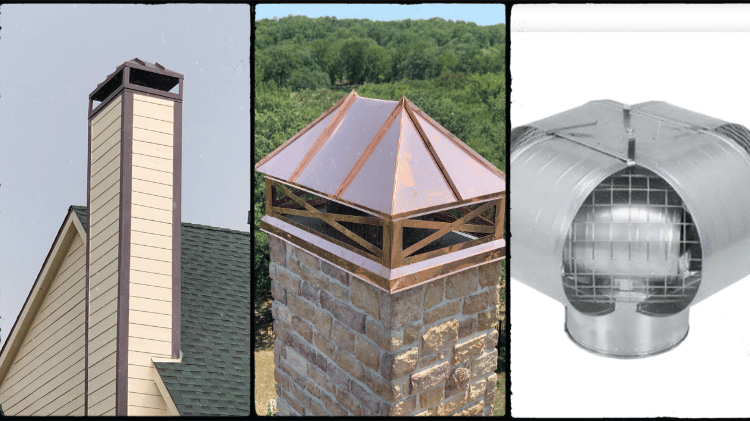
From left to right: copper full-coverage caps, stainless steel single-flue cap, and a wind-directional draft cap — each designed for different chimney configurations.
There’s a difference worth knowing. Flue caps — also called single-flue caps — protect only the flue pipe from debris, water, and animals. Chimney caps — also called full-coverage caps — cover the entire chimney crown as well as all flues beneath it, providing broader protection against water damage and structural deterioration.
Single-flue caps cover one flue opening and are the most common on residential chimneys in North Texas. They’re straightforward to install and replace.
When Sweeps N Ladders inspects a chimney, this is one of the first things it checks: not just whether the chimney has a cap, but whether it’s covering what it needs to cover.
Multi-flue caps — sometimes called top-mount caps — sit on top of the entire chimney crown and cover multiple flue openings under one unit. These are common on homes with two or more fireplaces sharing a single chimney structure. They also provide extra protection for the crown itself, which is a bonus.
Draft-increasing caps are designed with a wind-directional feature that actually improves airflow when the wind blows across the top. If you’ve had persistent smoke issues, this style is worth a conversation.
Material matters more than you’d think
The cap sitting on your chimney right now — if you have one — is most likely galvanized steel. It was cheap when it was installed, and it did the job for a while. But galvanized steel corrodes. In North Texas humidity, combined with the acidic byproducts that travel up the flue, a galvanized cap can start deteriorating in as little as five years.
Stainless steel is the standard upgrade. It resists corrosion, handles temperature swings, and typically carries a lifetime warranty from the manufacturer. For most homeowners, this is the right call.
Copper is the premium option. It lasts essentially forever and develops a patina over time that some homeowners prefer aesthetically. It costs more, but on a high-end home in Prosper or Frisco where curb appeal matters, it’s a reasonable investment.
The important thing is this: a cap that’s rusted through is worse than no cap at all, because it gives you the illusion of protection while letting water and debris pass right through the corroded spots. You think you’re covered. You’re not.
The animal problem nobody talks about
Every spring, Paul’s crew pulls bird nests, squirrel nests, and occasionally raccoon debris out of chimneys across McKinney, Celina, and the surrounding communities. It happens more than people realize.
An uncapped flue is a warm, sheltered, vertical cavity — exactly the kind of space animals are looking for when they’re nesting. Once they’re in, they bring nesting material that blocks airflow. Blocked airflow means combustion gases — including carbon monoxide — can’t vent properly. It also means the next time someone lights a fire without checking, that nesting material becomes fuel inside a confined space.
Chimney swifts are a particular issue in North Texas. They’re a federally protected migratory bird, which means once they’ve nested inside your flue, you legally cannot remove them until they leave on their own. A cap prevents the situation entirely. Without one, you may be waiting weeks.
Not sure if your cap is intact?
How to know yours needs attention
You probably can’t see your chimney cap from the ground in any useful detail. But there are signs that something’s wrong even without climbing a ladder:
Water stains on the ceiling or walls near your fireplace
Musty or damp smell from the firebox when not in use
Rust stains in the firebox or on the damper
Animal sounds — chirping, scratching, rustling — from the flue, especially in the spring
Any one of those is reason enough to call. A chimney inspection starts at $129 and covers the cap, crown, flashing, liner, damper, and firebox — top to bottom, the same way Paul walks every chimney he touches.
The math is simple
A new stainless steel chimney cap, installed, typically runs $150 to $300 depending on the flue size and configuration. A chimney liner replacement — the repair you’ll need if water has been running down an unprotected flue for a season or two — starts around $2,500 and can run past $3,000.
The cap is the cheapest component on the entire chimney. It’s also the one that protects everything else. That’s why Paul calls it the first line of defense — not because it’s the most complex piece, but because when it goes, everything below it is exposed.
What to do right now
If you’re reading this in the spring, the timing is right. Winter did the damage. The evidence is fresh. And before summer arrives and you close everything up and forget about it until October, there’s a narrow window to catch the small problem before it becomes the expensive one.
Schedule a chimney inspection or call (469) 777-8432. Paul and his crew will check your cap, your crown, your flashing, and everything below it — because your chimney connects everything, and it all starts at the top.
Schedule a chimney inspection