
How a Cracked Chimney Damages Your Home's Foundation
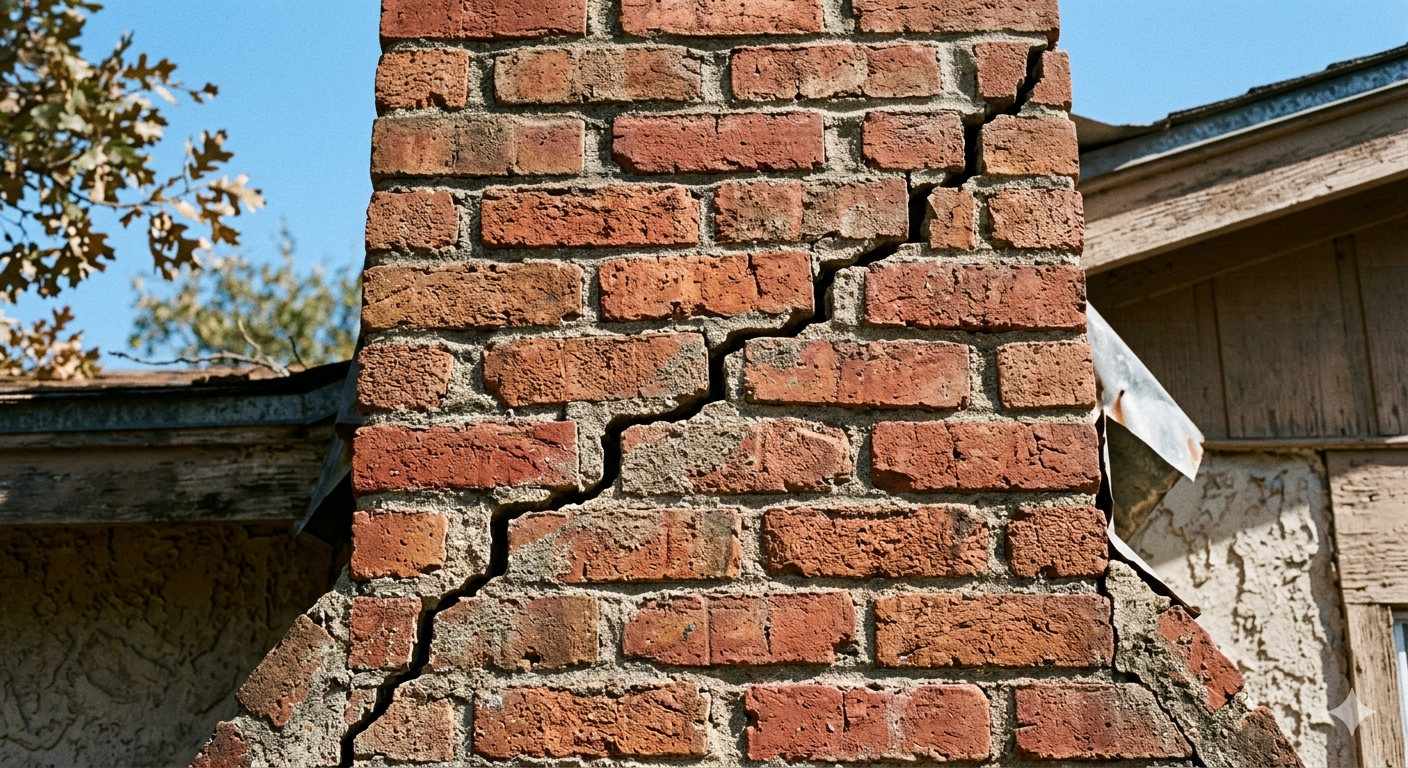
A red brick chimney with a major vertical crack running from the cap nearly to the roofline. Mortar joints are eroded and flashing is visible at the base, indicating long-term weather damage and probable structural compromise.
Your chimney isn't just a structure on the outside of your home — it's connected to the foundation beneath it. Water that enters at the top travels down through the entire column and can end up where you can't see it: in your subfloor and foundation framing.
How Water Gets In
Spalling brick — that flaking and crumbling you see on the outside — happens when moisture freezes inside the masonry. It's not just a cosmetic issue. As the brick deteriorates, the structural integrity of the entire chimney column weakens. Left unaddressed, it accelerates. Leave it long enough, and the column itself becomes compromised.
The Foundation Connection
In Texas, where homes sit on slabs or shallow piers and the soil moves constantly with rain and drought cycles, this matters even more. A chimney that's allowing water to travel is slowly working against the stability of the structure it sits inside. Moisture that entered at the roof can migrate all the way down to the base and into the foundation, where it causes hidden damage.
What This Means for Your Home
If your chimney is deteriorating on the outside, the water is already working inside. A professional inspection catches these issues before they become structural problems.
WHAT IS THE CHIMNEY EXTERIOR?
The chimney exterior is the visible masonry column you see from the curb — the brick or stone, the mortar joints holding it together, the crown (the concrete cap at the very top), and the flashing (the metal seal where the chimney meets the roofline). Think of it the way you'd think of a stack of cups: each layer needs to seal cleanly into the one below it, or water finds a path.
What most people don't realize is that the chimney exterior isn't just decorative masonry. It's a weather-exposed structural element that has to do three jobs at once: contain the flue gases moving up through the interior, shed water away from the roof and walls, and stay structurally tied into the rest of the house. When any one of those jobs starts to fail, the other two get harder.
Because it sits fully exposed to the elements — rain, sun, freeze-thaw cycles, hail — the chimney exterior takes more weather abuse than almost any other part of your home. In North Texas, where a single week can swing from 80°F to a hard freeze, that abuse adds up faster than most homeowners realize.
WHAT IS THE FOUNDATION CONNECTION?
Every chimney sits on something — and that something is part of your home's foundation. In North Texas, that usually means a concrete slab or a shallow pier-and-beam system. The chimney's weight is supported by a footing tied into the same foundation that supports the rest of your house.
This is why a problem at the top of the chimney can become a problem at the bottom of your home. The chimney column is, functionally, a vertical pipeline. Water that enters through a cracked crown, failed flashing, or spalling brick doesn't stay where it entered — it migrates downward through the masonry, into the framing where the chimney passes through the house, and eventually into the soil and footing at the base.
In Texas, that downward migration matters more than it does in other regions for one specific reason: expansive clay soil. The ground under your home swells when it's wet and shrinks when it's dry, and that movement is what causes the foundation issues North Texas homeowners deal with all the time. A chimney that's quietly delivering water to its own footing is feeding that cycle directly. The soil under the chimney expands and contracts more than the soil under the rest of the house, and the chimney can begin to pull, lean, or separate from the home it's attached to.
COMMON PROBLEMS — CHIMNEY EXTERIOR
The chimney exterior deals with sun, rain, freeze-thaw, and wind year after year. A few specific failures show up over and over.
Spalling brick. This is the flaking, pitting, and crumbling you can sometimes see on the outside of the chimney column. It happens when moisture gets absorbed into the brick, then freezes — and freezing water expands. The expansion pushes the face of the brick outward until pieces break off. It's not just cosmetic. As the brick deteriorates, the structural integrity of the entire chimney column weakens. Once spalling starts, it accelerates: every flake that comes off exposes more porous material to more moisture.
Cracked or deteriorating crown. The crown is the concrete cap on top of the chimney. Its job is to shed water away from the flue and the masonry below. When it cracks — and most crowns will, eventually, from sun exposure and thermal cycling — water pours straight down the inside of the column with nothing to stop it.
Failed flashing. Flashing is the metal seal where the chimney meets the roof. When the flashing pulls away, rusts through, or loses its caulk seal, water enters at the roofline and runs down the side of the chimney inside the wall — often showing up as ceiling stains far from the actual leak.
Mortar joint deterioration. The mortar between the bricks weathers faster than the brick itself. As it pulls back, recedes, or falls out, you get exposed paths for water to travel into the masonry. This is what tuckpointing addresses — removing failed mortar and packing in fresh material before the brick itself starts to suffer.
COMMON PROBLEMS — FOUNDATION CONNECTION
Foundation-side chimney problems are quieter than exterior ones. You usually don't see them until they're advanced.
Hidden moisture in the framing. Water that enters at the top of the chimney and travels down through the column will eventually hit the wood framing where the chimney passes through the house — the subfloor, the joists, the wall studs around the chase. Wet wood rots, attracts termites, and loses its load-bearing capacity. By the time you see a stain on a ceiling or a soft spot on a floor, the moisture has been at work for a while.
Chimney leaning or separating from the house. When the soil under the chimney's footing is consistently wetter than the soil under the rest of the house, the chimney can move independently of the structure. Homeowners notice this as a visible gap opening up between the chimney and the siding, a tilt that wasn't there before, or cracks in the masonry that follow a diagonal line.
Settlement cracks at the base. Cracks at the base of the chimney — particularly stair-step cracks following the mortar joints — usually indicate movement at the foundation level rather than just surface masonry damage. They tell you the soil under the chimney has shifted.
Efflorescence and staining at the bottom courses. The chalky white deposits sometimes visible at the base of a chimney are a sign that water has been moving through the masonry from above, depositing minerals as it dries. It's a tell that water is actively traveling the column, even if you can't see where it's getting in.
On Texas soil: A chimney that's allowing water to reach its own footing is working against the stability of the structure it sits inside. The same expansive-clay behavior our friends in foundation work see across DFW — heave in wet seasons, settlement in dry ones — gets amplified directly under a leaking chimney column. Catching the moisture path early at the chimney is dramatically cheaper than addressing the foundation movement it can cause downstream.
MAINTENANCE AND INSPECTION
Chimney exterior and foundation-related issues are almost entirely manageable when they're caught early. The work isn't complicated — it's mostly about not letting small problems grow into structural ones.
Annual chimney inspection. A Level 1 inspection covers the visible exterior — brick condition, mortar joints, crown, flashing, and the chimney's connection at the roofline and at the base. The technician notes anything that's allowing or about to allow water entry.
Crown repair or sealing. A cracked crown can often be sealed with a flexible, weatherproof crown coating before it requires a full replacement. Done early, this is one of the highest-value preventative repairs on the entire chimney.
Tuckpointing. When mortar joints are receding or crumbling, tuckpointing removes the failed material and replaces it with fresh mortar. It's far less expensive than a brick rebuild and stops the water path before it reaches the brick face.
Waterproofing. A breathable masonry sealer applied to the chimney exterior allows water vapor to escape from inside the column while preventing liquid water from being absorbed in. This is one of the most cost-effective ways to slow spalling on a chimney that's already showing early wear.
Flashing repair or replacement. Failed flashing rarely fixes itself — it gets worse every storm. Resealing or replacing the flashing at the roofline shuts down one of the most common water entry points before the damage spreads.
Serving North Texas Homeowners From McKinney to Dallas
Sweeps N Ladders serves homeowners across North Texas — McKinney, Celina, Prosper, Frisco, Plano, Allen, Dallas, and the surrounding DFW communities. Every chimney in this region faces the same combination of stresses: intense summer sun, sudden hard freezes, and an expansive-clay soil profile that makes any moisture reaching the foundation more consequential than it would be elsewhere.
Whether your home is a newer build with a prefab chase or an older masonry home with a full brick chimney, the exterior and foundation interaction is the same. A chimney that's been left without inspection for a few years — even one that looks fine from the driveway — can be moving water down through its own column and into framing or soil where the damage compounds quietly.
The good news is that exterior chimney issues are some of the most fixable problems in the entire home. A crown seal, a tuckpointing pass, or a flashing repair takes a single visit. Waterproofing the column extends the life of the brick by years. What makes these problems expensive is letting them go long enough that the chimney column, the framing, or the foundation itself starts to need work.
Sweeps N Ladders owner Paul Herman has over 700 five-star Google reviews from North Texas homeowners — not because the work is complicated, but because he shows up on time, explains what he finds, and doesn't sell you something you don't need.
For a deeper look at how your chimney exterior fits into the bigger picture of your chimney system, read our guide: Your Chimney Connects to Everything in Your Home.
-
Both — and it usually starts cosmetic and becomes structural. Early spalling is just surface flaking. As more brick face is lost, the column loses material and starts admitting more water, which accelerates the damage. By the time spalling is widespread, you're looking at masonry repair rather than waterproofing.
-
Yes, particularly in North Texas. The chimney column carries water downward, and the chimney's footing sits in the same expansive-clay soil profile that drives most foundation movement in DFW. A leaking chimney isn't usually the only cause of a foundation issue, but it can be a contributor — and it's often the easiest contributor to eliminate.
-
The terms get used interchangeably in casual conversation, but technically: repointing is removing deteriorated mortar and packing in fresh mortar. Tuckpointing is the same process plus a finishing technique that creates a fine line in the joint. For most homeowners, what you actually need is repointing — and most chimney pros will use the word "tuckpointing" to mean both.
-
A good masonry sealer typically lasts 7–10 years before needing reapplication. If your chimney is already showing spalling or mortar wear, those repairs need to happen first — sealing over damaged masonry just traps moisture inside.
-
It usually means the chimney is moving independently of the rest of the home, which points to soil movement at the chimney's footing. Small, stable gaps can sometimes be sealed and monitored. Growing gaps need a foundation professional involved alongside the chimney repair — the chimney work alone won't solve a movement issue.
-
The most common chimney problems in North Texas — crown cracks, failed flashing, early-stage mortar deterioration — are not visible from the ground. They're visible from the roof or from inside the flue. An annual Level 1 inspection is how those problems get caught while they're still inexpensive to fix.
Ready to Get Your Chimney Inspected?
If it's been more than a year since your chimney was inspected — or if you're noticing flaking brick, staining on the masonry, gaps at the roofline, or any signs of movement at the base — give us a call. We serve McKinney, Frisco, Celina, Prosper, Plano, Allen, Dallas, and surrounding North Texas communities.
Chimney Cleaning & Sweep: $229 Safety Inspection Only: $129
No runaround. Just a chimney sweep, with over 700 five-star reviews from your neighbors across North Texas.
📞 (469) 777-8432
Sweeps N Ladders — Chimney & Fireplace Services — North Texas